Wednesday, September 30, 2015

Le Voyage Part 3

A glacial wonderland

Today we're supposed to have the opportunity to view some wildlife and see a couple more glaciers. A couple more glaciers, hah. They're everywhere, but these will prove to be special glaciers.

When we awake and look out the window, we see it's cloudy and foggy. Landmasses are visible, though, and the scenery is impressive even if you can't quite see it clearly. We're going to Glacier Bay National Park and Preserve and will pick up some park rangers to act as guides. The cruise director made a comment the night before about them climbing rope ladders to board the ship, which I take as a joke. As it turns out, it's not. I don't notice that we ever come to a full stop, but in any case their boat comes alongside, a rope ladder is dropped, and the rangers clamber aboard. I hope they receive extra pay for doing that.

After breakfast, we head for the promenade deck, where the Sandra, the naturalist, has said she'll be helping passengers spot wildlife. It's raining now, and as we come to the stairs up to the bow, we meet a large group coming down. The guy in the front says, "And I got up early for that" as he goes by. We join a very small group on the deck around Sandra, who's explaining something to the group. Suddenly she shouts, "We have sea otters," and points. We rush over to the rail, cameras in hand, and start trying to shoot pictures. Other people begin seeing more otters, many in small groups, and we all stand happily in the rain and wind, shooting away.

Sandra explains that the otters float on their backs most of the time, and they have pockets of skin in which to carry rocks for cracking open shellfish. The very young ones take up position on mom's stomach as they float past. They seem to be used to seeing ship pass by, but occasionally a group  will dive if the ship comes close.
A group of otters swims by the ship

Eventually Sharon and I start to feel the cold and need to wipe the water off our cameras, so we step back and visit with the naturalist a bit. She's disappointed that so many people left. She also says they'd spotted a hunchback and an orca shortly after nine, when she'd started her stint. Don't know if any of that disgruntled bunch saw the whales, but I'm guessing not, given the reaction.

One of the park rangers is scheduled to give a lecture at 10, and we decide to take it in, as much to dry out and warm up as anything, but the talk is informative.

Afterward, we decide to visit a spot above the covered pools where the rangers have set up a display. About the time we arrive in that area of the ship, one of the rangers begins a PA broadcast from the bridge. She spots some mountain goats on the starboard side of the ship, and passenger begin a mini-stampede for the nearest exit to the outside deck. One woman shoves me out of the way just after I go through the door in her rush to the rail to take a picture.

I don't mean to stereotype, but my memory of older people is that once upon a time they tended to be more polite than other age groups. I'm used to children shoving past me, but adults living together in limited space should know better. But so far I've been far more likely to be cut off, shoved and generally treated as though I don't exist by the older people on board than the younger ones.

Out on deck, people start pointing at the shore and taking pictures. I look through my zoom in the direction they're pointing, but the only things I see look like rocks. Sharon eventually spots a group of the goats and manages to get a couple of pics that confirm she has indeed spotted the goats. Looking at her pics is the only way I see the critters.

It's not long before we're frozen again (Let it go! Let it go!), so we go back in, check the schedule at the ranger's display and head for a hot drink and snack. The materials we've been given indicate that most of the cool stuff to see will be on the starboard side of the boat, where our room is, and we go back there. The rain lets up, and we're protected better on our balcony than we were on the lower outside deck. The further we travel into the bay, the more the clouds relent, and by the time we reach the first set of glaciers, sun is peeking through occasionally. Sweet.

The two glaciers we're going to see, the Grand Pacific and the Margerie flow into the bay right next to each other, one to the northeast, the other to the northwest. The Grand Pacific is receding and doesn't register as being a glacier at first because the face is dark and looks much like land because it is covered in debris, mostly rocks and dirt from landslided. The first ranger we heard earlier had warned us we might think, "That's not a glacier."
The Grand Pacific glacier -- its that dark mass running
through the middle of the picture. No, really, that's a glacier.

On our approach the face of the Margerie is visible to our left, looking like a proper glacier, for a short while before we come to a halt, and the captain pivots the boat starboard. We can see the full face of the Grand Pacific, but none of the Margerie.

After some while, I check the time and see that it's just a half hour till we depart. The captain is supposed to pivot the boat so those of us in our starboard rooms will be able to see the Margerie, but I'm afraid we'll miss something so we head down to the promenade and go outside on the port side, where the Margerie looms before us in all it's glory. I ask a small group of passengers if they'd seen the ice calve yet, and one woman excitedly tells me they had, and she had video of it on her iPhone.

Not long after, Sharon sees some "small" pieces fall off. I say "small" because of that perspective thing. They could be as big as a car for all I know. Soon, we begin to hear the cracks and booms, then Sharon calls out, "Look, it's starting over there," and points to my left. I whip my camera up and see some ice falling. Then we hear another boom, and a big chunk of the face calves off. I manage to shoot three or four times and capture some of the event.


Shortly, the ship begins turning to port to head back the way we came.We scoot back up to our room for the next leg, which will take us to the Johns Hopkins Inlet to see the John Hopkins Glacier. Both are named, by the way, for the institution, not the man. The man who named it, Harry Reid, had attended Johns Hopkins. This segment of the passage is one of those "dittos" I mentioned in the first post, just one spectacular view after another. At this point, I've run out of superlatives. My camera's getting a workout. From time to time, I stop shooting so I can sit and absorb the beauty we're passing through.

The ranger broadcasting on the PA comments this area lies along a fault, and the two rock plates that come together here are composed of different types of rock. The uplift that shows where the two are "stitched" together reveals the stark contrast in the makeup of the rock.

Another thing she points out is something Sharon and I have already discussed: the sound that the ice floes make as we pass by. Ever drop an Alka Seltzer or one of those flavored fizzy tablets into a cup of water? Remember that fizzy sound? Well that's what we're hearing, along with some slushing sounds as the ice rocks in the small bow waves the slowly moving ship makes. I recorded the sound on my iPod, where it sounds more like someone left water running slowly in a tub.


Almost every glacier we've seen has an associated waterfall. From our vantage on the ship, at some distance away, the flows appear to be rivulets wandering down the mountain. Take a close look through the zoom, and you can clearly see they are more like rivers with great crashing waterfalls. On one occasion, we're close enough to the shore to be able to hear the roar of one of the falls.

Once we turn to head out of the bay, the ship picks up speed, and our pass of the "lesser" Lamplugh and Reid glaciers goes by pretty quickly. The Reid, by the way, was named after Harry Reid, just not by him. While sitting and occasionally standing, we continue to give our cameras a workout. After passing the Reid glacier, we decide we're cold and tired and ready for a nap. We'll wind up skipping the evening session with the naturalist, when she plans to look for wildlife again.

The evening would be spent recuperating and attending some of the on-board entertainment. Two shows are scheduled, and we take in the later showings of each, scurrying from one venue to the next. The shows are good, but I'd say the talent we've had on our other cruises outclasses this bunch.

Warning: Another ageist statement ahead. I've noticed that the early shows are packed. So much so that we don't even bother trying to go at those times. Attendance at the late shows has varied but is always much lighter. Could it have something to do with the age of the crowd? Maybe more of them wan to go to bed early than want to stay up late? Who knows?

Sunday, September 27, 2015

Le Voyage continues


Gaining perspective

Good night's sleep. Should be after going to bed at the equivalent of 2 in the morning, though we're three hours behind that, local time. We lie about, looking at the activities for the day in the ship's newsletter and making some plans, then we dress and head for breakfast.

We'd gone to Maine a few years back during a September, and a cruise ship docked at Bar Harbor while we were there. At the time I remarked that I had never seen so many old people in my life. That's pretty much true for this trip -- populated with old people (which I realize includes us). We do see some couples with kids, though my guess would be grandparents taking the kids on a big adventure (though why they do that during the school year, I can't fathom.) The younger adults on board either are sans children or traveling with preschool age children. Even with their presence on board, I'd put the average age in the 60s.

We follow our leisurely breakfast with attendance at a lecture from a naturalist, Sandra Schemp, a retired professor from NewYork, hired by the cruise line to enhance our experience. She clues us in as to the wildlife we might see see and when she'll be available to help us spot the critters. Among the things she says is that she likes to say you can't sit and watch the water for an hour without seeing something. Sure enough, while I'm writing this, Sharon spots blows in the water outside our window. We can't ID what we're looking at, but I count it as a prediction confirmed.

Later we attend a second lecture and catch Schemp afterward. She's excited to hear we saw something, and after asking a few questions says we probably saw humpbacks (insert your own Star Trek joke here.) Her questions make it possible for us to ID the next bunch of animals to flash past us as Dall's porpoises. They hang around long enough for us to theoretically get pictures, but we have a hard time finding them in our viewfinders and focusing. I point my camera in the general direction and hit the shutter. Later we'll find out that the tactic worked. I'm not zoomed all the way out, but in the bottom of the frame, you can see four spots. Blown up sufficiently you can tell that they're fins.

The big event of the day is sailing into Yakutat Bay to view the Hubbard Glacier. Off our balcony we can see enormous mountains rising through the mist and clouds. I read in something we have that this area is home to many of Alaska's tallest mountains. We won't see Denali while we're here, but these mountains are plenty impressive.
High mountain peaks along the coast of Alaska as
we enter Yakutat Bay.


We spot the glacier some distance away, which leads me to the ludicrous thought, "That's it?" I've no sense of distance, but I'm guessing that we're seeing the big ice river 20 or 30 miles away, the distance we were able to see mountains in Scotland from the coast of Ireland. Schemp told us it's the longest tidewater glacier in North America, and from where we are, you can see that it stretches quite a distance. Actually, it stretches 72 miles, and the face will stand some 350 feet above the waterline.

But the distance throws off my perspective. The glacier doesn't look that tall or that long, not that you can see the whole length. Of course it grows as we near, but at one point we decide we're too cold standing around watching as we near and need to go in for a bit, and we'll just see what it looks like when we're close to being at our arrival spot.
The face of Hubbard Glacier as it enters Disenchanted Bay.
Our naturalist says it's six miles wide, and the dark stripe
in the middle was caused by two glaciers meeting
to form the Hubbard.


We wander about the gift shop for a bit and pick up a companion for my Maine moose -- a stuffed animal I have previously enthused about as being "the cutest thing" -- then head back for the promenade deck. As soon as I can see through the glass doors, I turn to Sharon, telling her to "come see this!" Ice chunks float everywhere. Big ones, little ones. Not Titanic sized ones, but big enough, I'm guessing. Some are surely as big or bigger than some of the fishing boats we've seen.

Then we walk outside and see how close we've come to the glacier. It towers above our ship, all it's features suddenly visible. We are both suitably awed.


The captain will bring the ship very close, though how close I've no idea, especially now I've learned my lesson about perspective. But ridiculously close. He'll hold position for a while before turning the ship back and forth so people in the balcony rooms on both sides of the ship can view the glacier from their rooms. We're on the bow end of the promenade deck most of the time, watching and listening to the cracking and booming sounds the glacier makes.
Chunks of ice flow out  from a recent calving, or breaking off
of a part of the glacial face.


Sharon sees the first ice calve off the face. And she'll see several more. Takes me a bit to see anything more than the splashes that mark the aftermath, but I eventually see a chunk break off that's large even I can't miss it and watch it plunge into the water. Neither of us actually manages to get a picture of one of these calvings, though. We spend an hour, hour and a half or so before the ship heads back out of the bay. Remember "ditto" from the first post? Well, "ditto."


We've been on the water for less than two days. Long range forecasts indicate we may be in for some rain, but we decide what we've seen so far has made the trip, even if the rest is a wash.
A portion of the Hubbard Glacier a bit closer up.

Saturday, September 26, 2015

Le Voyage Fantastique

 Our Alaskan adventure begins 

My day actually begins early when a cramp forms in my calf faster than I can deal with it. That means jumping out of bed and walking/stretching to reduce the acuteness of the pain. Once I can return safely to my bed I begin to wonder what I forgot to pack the night before, why we only printed one boarding pass for each of us when we're going to have to catch two planes -- all the stuff I worry about before leaving on a trip. Oh, and for the flight out, our boarding pass is good for both legs of the journey.

Then I glance at the clock and note it will be another hour and a half before the alarm goes off, and I've only been asleep for about 4 hours. I'll need that hour and a half to get up to the average amount of sleep I've had the two previous night, so I try to clear my mind, and for once it works. The next sound I hear is the annoying alarm I picked on my tablet the night before. Just to be sure, I had also set another device with an alarm, which sounds off a few seconds later.

We're up and making last minute preparations, but we apparently did a good job of packing, as little remains to be dealt with. I'd gotten it in my head that we were supposed to fly out at 8 a.m., and I'm surprised when I check the airport web site and discover we don't leave til 9. But that's OK. The extra hour cushion will allow us to make a leisurely arrival, something we don't often do, and that means I won't be such a pain worrying about everything while I'm driving to the airport.

Because it's the Labor Day weekend, we don't want to take our chances on the airport's remote parking having space -- they were full on July Fourth -- or spend more money on one of the interior lots, I've made reservations at an off-site lot. I may do that every time. We're given a specific row to park on, and the bus drives up right next to us for convenient off-loading of our bags. The driver gives me a card that tells me exactly where I'm parked. He gives ma a card with the info on it and says to give it to whoever brings us back from the airport. That driver will drop us off right there. Much better than the remote parking, and it's cheaper.

We pick up several other passengers, and fortuitously, we are all headed to the same terminal, though Sharon and I will be on another airline from everyone else. Once at the terminal we walk forever to the Alaska Airlines check-in and speed through the process. We're amazed at the security procedures -- no need to remove shoes or belts, just walk through the metal detector, pick up our bags and head for the gates, possibly because of the TSA pre-check stamp on our boarding passes. Just like we encountered in Ireland two years ago. Never did understand why a country that had endured more strife than ours seemed to have easier security.

Microsoft bought us breakfast at one of ubiquitous airport Starbucks locations. (If you sign up on Bing and do a bunch of worthless searches each day, you earn points redeemable for stuff. They get to brag about how many searches are done with their browser; you get free stuff. Seems reasonable to me, even though I've yielded yet more information about myself to cyberspace.) When the shop starts to become crowded Sharon says we should go sit in the gate waiting area and leave room for the customers coming in. It almost breaks my heart to be considerate of others, but I agree anyway.

While waiting for our flight, we are treated to a spectacle that comes straight out of a movie. A  flight for Detroit is about to leave, and an older, overweight man appears down the hallway, huffing and panting and walking as fast as he can.

"Detroit?" he wheezes out in a raspy voice.

"What's your name, sir?" the gate attendant asks. He replies in that same rasping, wheezing voice that now also seems to be failing. I hope he didn't have a heart attack or something on the plane.

Finally it's our turn to board. When we'd checked the seating on the website, the seat next to us showed to be empty. As passengers boarded, it appeared the seat would remain empty, but the last person down theplane's aisle -- a young man about college age -- appeared and dropped into the seat next to me. I'm sure he's a nice fella, but my hopes for extra space were dashed. Oh, well. Nothing to do now but sit back, hope we arrive in Seattle in time for our next flight, and go on to meet our boat.

The flight to Seattle goes well, a highlight coming when Sharon spots a mountaintop poking up out of the clouds. Given our flight altitude and the size of the peak, I figure it's a pretty big mountain. We'll attempt to find out which one it was later.
Mt. Ranier from our plane window as we fly into Seattle


We arrive a little later than planned, but the gate we arrive at is a change from the schedule, and we wind up very close to our connection gate. That gives us just enough time to grab a sandwich at one of the nearby shops and get on our next plane. (Alaska Air doesn't include meals in the ticket fee, and their selection of food for purchase is limited on our flight.)

We're seated almost in the very back of the plane, and our seat mate in the back of the plane is a young man who just graduated law school in Oregon and is traveling to a job clerking for a judge in Barrow, AK. He a chatty thing who has spent some time living in Alaska and tells us what he knows (or says he knows) about places we're going to and points out features visible through the plane window.

Sharon shows him the picture of the mountaintop, and he says he thinks it could be Mt. Ranier. I'll check it when we have access to some sort of map.

Our fare also doesn't include any in-flight entertainment we're actually interested in -- some Discovery and NatGeo shows and some indie stuff for free, but everything else carries a fee. I'd ripped some of our DVDs and brought along a selection of movies to watch on my tablet, so we plug it all in and watch a movie, which helps pass the time.

Our arrival in Anchorage puts the last of my worries to rest. On our first cruise 19 years ago, with Royal Caribbean, we arrived at the airport, picked up our bags, and then had no idea how to find our transportation to the ship. In Anchorage, the Princess people are stationed right outside the baggage claim area and give explicit directions on how to proceed. Easy peasy, lemon squeezy.

The ship anchors in Whittier, and the shuttle ride is supposed to take an hour and 40 minutes. As soon as we jump on the coastal highway, the whole trip seemed totally worth it. We are treated to some kind of beautiful scenery. And, though it's cloudy when we arrive,  the clouds clear as we travel so that by the time we reach the ship, it's mostly sunny and the views are stunning.

While on the way, our driver points out a bald eagle sitting atop a dead tree. We'll see at least one other but fail to photograph either. Still, a bald eagle. Pretty cool for a small-town Texas boy like me who missed a sighting of one several years back in Cleburne.

The driver determines that we're a bit ahead of schedule so he turns into a pull-out with a view of Explorer Glacier and lets us take pics. Most everyone takes pics with their cameras or tablets(!), and the most common pic I see being taken is the selfie. No more need to grab a stranger to take a pic of you in front of whatever interesting background you encounter. Though why people use tablets to take pictures with, I don't quite understand. They never seem to use the smaller ones, and it seems ungainly to me to take a photo with an iPad or a nine or 10 inch Android tablet with the cover hanging down.

The driver tells us that Whittier used to be the location of a secret military base during World War II, and was only accessible by sea or air. The powers that be decided a land route was needed, so they commissioned a tunnel through a mountain to Whittier.
Whittier at twilight as we're pulling away from the dock.

But they only built a one-lane-wide tunnel that provides both road and rail access to the town. That's right, I said one-lane and road-and-rail in the same sentence. Inbound traffic goes through the tunnel on the half hour, and outbound traffic goes through on the hour, assuming a train doesn't need to go through.

Then traffic, which shares its roadbed with the train tracks, stops both ways while the train goes through. And according to our driver, the atmosphere inside the tunnel is cleared before traffic goes through. Plus, traffic is spaced out so the truck in front of us is about half way through before we start in. Our driver's a bit of a wag and plays the theme music to Raiders of the Lost Ark while we travel through the tunnel.

As soon as we emerge from the tunnel, we see the ship. Another great view. If I write "ditto" in the future notes, take note that it will mean "another great view."

Our check-in is the easiest we've ever gone through. Maybe it's because we're sailing in September; maybe it's the hour we're checking in, but I'm happy. I like low stress, especially on vacation. We haven't eaten in a while so we head for the buffet. After that we explore the ship and enjoy one "ditto" after another whenever we step outside.

Eventually, after taking the first of way too many pictures, we return to our room to crash for the evening. By the time I've sifted through all the material provided passengers and decided to call it a day, it's been almost 21 hours. Sharon checked out a bit earlier, but it's safe to say neither of us has been up that long in years.

Wednesday, November 13, 2013

Do the Irish like potatoes? Beer? Are you sane?

Random thoughts that didn't make it into previous postings:

Food

A co-worker asked me about food after we returned, and as I recall, I didn't have much to say. We didn't eat anything exotic while there, but that doesn't mean the opportunity didn't present itself.

Each day started with what was called an "Irish breakfast." For us, this was a buffet, and the specific items offered differed according to the hotel we were in. But we always had scrambled eggs and sometimes had what looked to me to be poached eggs, but one server called them fried.

A large pan of scrambled eggs would be cooked to varying degrees. If you liked yours runny, they would be at the bottom or to the side. The most-cooked eggs would sometimes be overcooked and dried out. Some days it was hard to find a happy medium.

A variety of meats were also served, sausage, bacon and carved slices of cold meats, for a sandwich, I suppose, or just to eat if you like that sort of thing. The sausage was OK, but kind of bland, and the bacon was more like slices of ham than the strips of smoked goodness we eat over here.

Vegetables were also available -- stuff like navy beans, tomatoes, mushrooms and some unidentifiable, to me, greens. Of course potatoes were served, pretty much in the form we'd identify as hash browns. Along with the potatoes, and looking very much like some form of potato, they would serve white pudding. Black, or blood, pudding was also available. Now, I don't know what you think of when you think of pudding, but if you have images of Bill Cosby hawking Jello pudding with a bunch of cute kids, push that out of your mind.

These puddings are supposed to be a type of sausage. Look up the ingredients on the Internet, and they sound relatively benign, but to my messed up taste buds, white pudding was just awful. I'd grabbed some by mistake, thinking I was getting potatoes. And black pudding is called that because it's black -- quite unappealing to me, though some in our group tried it and declared it to be "not bad." Not exactly a ringing endorsement.
My salad one night. I took a picture because that's a quail
or duck or something other than a chicken egg. Tasted the
same, though.

Cold cereals were available, along with a selection of juices. But the best part was the breads. Two, three, four styles of bread would be served along with that wonderful creation called a scone. I know people over hear who don't like scones -- which is the word they use for biscuit because they call cookies biscuits -- because they're dry and not very tasty. These scones, some with fruit, some without, were more like the best country biscuits you ever had. Team them up with butter -- they also served margarine, but hey, if you're blowing your calories, might as well go for the real thing.

All the breads appeared to be handmade, most some form of whole grain or multigrain, and I don't remember a plain, white bread ever being served, unless you count the dinner rolls, but plain doesn't really describe the taste of those rolls. I could have made a meal just from the breads we were served every day.

Lunches varied in content wildly. At one museum cafe we had "vegetable" soup, which was nothing like our conception of veggie soup. I think that the primary vegetable was parsnips, and I've no idea what else was in it, but it came out as a thin puree that we found quite tasty. And, of course, the bread served with it was wonderful. We missed a couple of lunches by being too busy sightseeing and taking pictures, but we had fish and chips a couple of times, and a couple of meals so ordinary they don't register with me this long after the trip.

Convenience stores dot the landscape and occupy buildings in town with the standard snacks and a bunch of cake and cookie concoctions we'd never heard of. Most stores carried Coca-Cola and Diet Coke, and surprisingly to me, many of them carried Dr Pepper, but not in diet or 10 calorie. My favorite drink was a carbonated orange drink you could buy with or without pulp.

Dinners, or suppers, or whatever you call them, were almost always at the hotel. I wasn't used to hotels having their own restaurants, but I suspect these are the classier hotels -- certainly the ones in Dublin and Belfast were -- and Holiday Inn is a splurge for me.

The meals were all multicourse, and we had a limited menu to choose from as part of our package. Fish seemed to always be on the menu, and beef, pork and chicken were served as well. I think one night the menu featured duck. Usually we were served a large portion of meat and small portions of steamed vegetables, parsnips and two kinds of potatoes -- some combination of mashed, roasted or boiled -- and bread, of course. I didn't have a clunker the entire time, but I think Sharon was less than enthused about one of her meals, though I don't remember which one. We'd also be offered a desert, and there was always an option that wasn't so sweet I couldn't eat it.

One last thing about food. I like tea, so I was in nirvana because Irish tea has a robust flavor sadly lacking in the black teas we buy here (mostly because I'm too cheap to buy the higher end teas offered in the stores.) But at one meal I asked the waiter for tea, and this flummoxed him. He told me that tea and coffee would be served after the meal. So I asked if I couldn't have some with the meal. He assented, but I still came away thinking I'd done something socially unacceptable.

Beer

Want to know how much alcohol features in Irish culture? Well, just walk down a block in a business district. If you don't find at least two pubs, you're in the wrong part of town. And Arthur Guinness has his own day in Ireland. It's called Arthur Day, and towns all over have festivals on that day. Really.

While driving around Dublin on our first day, I noticed a gleaming tanker truck. You know, the kind you see occasionally running around here that usually has a big milk logo or sign on it. Then I noticed that this tanker was marked with a Guinness label. I tried to get a picture, but traffic and angles and all that nonsense interfered. Still, I had to wonder what the tanker hauled. Beer? Do they offload beer at taverns into big storage tanks like gasoline? Was it on its way to a bottling plant? Maybe just carrying water to be used in the brewing process?

Guinness must be poured in a special way. At least that's what an article in the onboard magazine on our American flight said. You pour it, let it settle, and pour again in some manner that creates a froth about an inch to an inch and a half deep on top.

Yes, I tried a pint. We had a welcoming gathering and a farewell gathering in which the drinks were "on us," meaning the tour company. Of course you know it's included in the price of your tour. But since it wouldn't cost me extra, I had one. Honestly, my favorite part was the froth. It tasted really good. To me, anyway. The beer's pretty good as well. Were I a drinking man, I could get used to it quickly, though the drinkers in our group, which was most of the group, said the American version's not quite as good. Maybe because it wasn't poured correctly.

Our guide pointed out one of the pubs, Farrington's I think, because it dates back to the early 1800s and features partitions to create private spaces. If I heard him correctly, the place was a favorite among clergy who didn't always want to be seen drinking in public.

Signs

Most places you visit will have cleverly named shops or some other sign that catches your eye -- like the one from Adventure Island tours that said they'd been doing so well, they'd moved to new digs. Here are a few that caught my eye:

Shop signs -- "Knobs and Knockers," door fittings, in Dublin; Baldies Barbers (do baldies need barbers, or was that the name of the owner, or just a bit of humor?) in Derry; Upper Cuts, barber shop in Donegal (They give your hair a fighting chance?)

Best name for a hotel -- Snoozles

Religious sign -- Ringed around a clock at the Larn Mission House in Belfast: It's time to seek the Lord. (Hokey, I know, but it made me feel like a Salvation Army Band could walk out and break into music at any moment.)

Transportation

Bikes for rent. 
In the large cities, public transportation was readily available. Buses and trains ran all over the place. Dublin had electric trains, and I came close to being run over by one of them, despite numerous signs warning pedestrians to be on the lookout. My problem was that it was our first day in the country, and I wasn't used to looking the correct direction yet. Or maybe I was jet-lagged. Or maybe I'm like the stupid people who ignore the signs at the Cliffs of Moher. But I nearly stepped into the path of an oncoming train. Sharon saved me. Again.

Dublin had bicycles for rent all over town. The whole set up looks like the program they recently started in Fort Worth. Sean, our guide, claimed that a Dubliner came up with the concept first.

Small cars dominate, which you would expect when gasoline costs upward of $7 a gallon, but Sean told us that the yearly registration and taxes are based on the displacement of your engine. Want to drive a big car with a big engine? Fine, but you're gonna pay for it.

To tour or not to tour

Do enough researching on the Internet, and you'll find two dominant opinions about how to visit Ireland. One is to go over there, rent a car, and go exploring. You're limited on a tour, which is true in many ways. Were I better driver (I may not be 5 of the top 10 worst drivers you'll ever meet, but my percentile ranking among all drivers probably isn't good) I would gladly take this advice.
Our group

The other opinion is to take a tour. Ours was much like going on a cruise. Our luggage was handled for us; the rooms and restaurants were above average; and the itinerary took us to many popular spots that fulfill the tourist idea of Ireland. Although you're not always seeing "real" Ireland, you have opportunities to go walk about and experience some of the authentic culture. And the pub crawlers in our group found lots of chances to visit with the locals. 

I was at times frustrated because even though I didn't have to do everything on the tour, precious little of what was offered failed to interest to me. I wanted to do it all, even if it meant that I couldn't indulge some whim. That's why we missed a couple of lunches, but we learned to take a scone and a piece of fruit with us and could always find a convenience store or small grocery where we could pick up a snack to tide us through. If you hate cruises, don't take a tour. But if you want a worry-free jaunt through some of the most beautiful scenery you've seen, a tour may be just right. And you'll meet some nice people.

On the bus ride from the airport to our parking lot at DFW, the driver asked if Ireland was as pretty as it looked in the movies. We both immediately replied with something like, "Yes, and even better."

More wonders remain to be explored in the years ahead. But it'll be tough to knock this one off our top 10 list. (Of course, I already have about five ties for first place.)


Monday, November 11, 2013

The Last Day

(Note: When you dawdle, you may put yourself in a bind. Which I have done. Our desktop computer, which contains all my Ireland photos, and which I kept telling myself needed to be backed up, is on the fritz. I'm hoping it will be fixed with all the contents intact. Fortune has it that Sharon's pics are all available on her laptop, so all the included photos in this post will be hers. At the end of my next -- and last Ireland -- post, I will include a link to our Flickr sites so you can see all the photos you can stand.)

I'd like to say the final day of our sojourn broke with bright sunlight and the promise of perfect traveling weather. But most of the day will be cloudy, foggy, rainy -- what you would probably think of as Irish weather. 

The sun does break out during lunch, but honestly, the weather's been so good during our trip that almost everywhere we've gone, some local person has remarked about how nice it's been. I'm sure they say that to all the tourists, but we're happy to take credit. We certainly can't complain about this day's weather.
Poulnabrone, in the Burren


The first part of our trip will be through the Connemara region, Note that I said region and not county. Most, or all, of Connemara lies in County Galway. The two items our guide, Sean, mention in connection with this area are marble and the 1950s movie The Quiet Man, which starred John Wayne and Maureen O'Hara, portions of which were filmed in County Galway and Connemara. 

Our first stop of the day will be at the Connemara Marble visitor center in the town of Moycullen. Our bus will park across the street from the center, and because enough traffic passes through town on this highway, we will be watched over by crossing guards, a first for the trip. In most of the places we've been, drivers have been most considerate of pedestrians, stopping for tourists and locals alike, who simply wander across the street when ready. Even in the bigger cities of Dublin and Belfast, which have marked crossings and automated crossing signs, we saw groups of people walk across the road without bothering to push the button for a "Walk" signal. 

A man at the center gives us a talk about Connemara marble, which comes in a number of colors. (Should my hard drive be recovered, I'll post the video here.) The coolest slabs are black spotted with white markings. If you look closely at the white spots, you notice that most of them are fossils. Marble quarried in the are was used in the cathedral at nearby Galway. We make a short stop at the cathedral after our center visit to see the magnificent marble floors. Unfortunately, church services are about to be held, so we're only able to spend  a short amount of time at the church. 

The guy giving the talk also mentions that Connemara marble was used in the state Capitol building in Pennsylvania.

Although our sheet of daily activities indicates we'll have time to wander about Galway on our own, we're not given the opportunity. Go figure.

From Moycullen we drive to an area known as the Burren. Limestone dominates the landscape, and the interesting feature here is that the exposed limestone contains huge cracks, giving the impressions of large, flat stones scattered about the countryside. One of the well-known sites in the Burren is Poulnabrone, a portal dolmen, or type of gravesite, dating to the Neolithic era. 

Large slabs of rock rise perpendicular to the earth and are capped by another large stone. Archaeological digs at the site unearthed the remains of about 30 adults and children who had been buried under the portal along with personal items.

The site contains a number of interpretive signs that explain the geology of the Burren and the discoveries that have been made there, but once again our guide is keen to keep us on schedule, so we really don't have time to do much reading or exploring. Though not as impressive as I imagine Stonehenge to be, I'm still impressed that the Neolithic inhabitants of the area managed to build this structure. Of course, being a fan of the show Ancient Aliens, I immediately jump to the idea that ET must have had some role here. 
Pier at Ballyvaughn.


We'll stop in the coastal town of Ballyvaughn for lunch. The sun's appearance means that as  soon as we've consumed our meal, we head outside to take pictures. A concrete pier extends from the shore, and a group swims down near its end. I'm guessing that had to be cold. 

The piece de resistance of the day is a stop at the Cliffs of Moher. The magnificent cliffs rise  some 700 feet above the sea and stretch across 5 miles of the Atlantic coast. A number of trails lead to various viewing spots, and you can see a trio of islands called the Aran Islands off in the distance. Fog has set in, and we'll be rained on a bit, but the weather enhances the experience. I'd have to admit that the whole thing would be spectacular on a bright, sunny day as well. 

We take one of the trails that leads near the cliffs' edge. Walls have been built to keep people from venturing too close to the edge, but numerous tourists ignore the wall, which is a bit less than waist high, and clamber over it to have their picture taken as near the edge as they dare go. As you might expect when people are being stupid like that, some folks in the past have misjudged and fallen to their death. 
Cliffs of Moher


As a side note, the cliffs are movie stars. They show up in a Harry Potter movie, The Half-blood Prince, among others, but that's the one most people are likely to have actually heard of.

From there we travel to our final destination, the town of Shannon. We'll stay in a hotel across the road from Bunratty Castle. The castle was built in the 15th century and now functions as a living heritage museum. We won't be wandering the grounds, but we do walk down to have a look. Like most living history places, the castle grounds contain buildings of the period and demonstrations are staged at various times. 

One of the main attractions at the castle takes place in the evenings -- a medieval "feast" complete with entertainment. (Again, I'll post video if it's recovered.) We're welcomed to the castle by staff in period garb and ushered into a large room where we are served mead and listen to a singer. The mead is potent and served in very small cups. I try it -- you catch the flavor of honey at the beginning of a sip, but this stuff is way stronger than beer, so I only drink about half. Sharon doesn't like the taste at all and has no more than the sip I urged her to take to see if she can taste  the honey -- she can't.
Sign on the wall meant to keep you away from the
edge so you don't do what the figure in the sign does.


Some of our crew seem to think it's pretty good and consume two or three drinks. Red and white wine will be served with the meal, so by the end of the evening, some members of the group will be feeling no pain. 

After 20 or 30 minutes, we're lead into a larger hall where dinner will be served. The meal is good. Home-baked bread, parsnip soup, spare ribs, chicken. But the only utensil we're supplied with is a knife. You eat with your hands and drink your soup from the bowl. The bread was wonderful -- I could have eaten that all night. Water is provided for those who don't want or need any more alcohol. 

The servers are also our entertainment. Between serving courses, brief explanations are given about the dining habits and foods of the time, and after the main course is served, they sing a variety of songs, including, of course, "Londonderry Air," better known as "Danny Boy."

Also during the festivities, the staff pick on one of the audience members, trumping up some charge against him and tossing him into a small cell at the side of the room. This night they pick a very short Scotsman who's apparently there with a group of fellow retired RAF officers. He'd come over during the serving of mead and visited with us, which is how I knew he was retired RAF. To be set free from his confinement, he's call upon to sing, which he does with gusto and a fine tenor voice, and is joined by the members of his group on the chorus of the song.

The evening proves to be a grand topper to our time in Ireland. We walk back to our hotel, which involves crossing a highway without the benefit of a light or a crossing guard, but it's after 11, so there's not a lot of worry involved.

In the morning we'll board a bus for the airport and head for home. Our time was brief but full of the kind of moments that make for great memories. We wish we could have stayed longer but are grateful for the time spent. 

I'll have one more blog with some random thoughts and a couple of more pictures, If you've muddled through these ramblings, thanks for taking the time to join our journey, if only vicariously.

Monday, November 4, 2013

The Pirate Queen

Westport in County Mayo bills itself as one of Ireland's premiere tourist destinations, but you wouldn't think that while listening to our guide describe it.

He tells us that the town only has four streets, and he's not far off. Four main streets make up the area of town where most of the businesses lie -- two longer streets that stretch up from the river that runs through town and the two streets that connect them. When we arrive, we drive around that circuit. Of course, the town has more streets where the residence are, but it's not a large town.

After we check into our hotel, we decide to go for a walk back into the town. I notice a sign for a river walk, and we take it to town. The river walk is nothing like San Antonio's or even Belfast's. An improved path borders a small river -- more like what we would call a creek, only 12-15 feet wide.

One of our merry band dresses up for our visit
to the house of a descendant of the Pirate
Queen and picks sides for the upcoming
hurling match against County Clare.
The part that leads from our hotel to the main section of town is has broad, green lawns, and a young couple sit underneath a tree, watching the ducks and chatting. The walk takes us to one of the cross streets. One side of the river in this part of town contains a line of shops about two blocks long that a map I look at later labels as a "mall."

Some of the bridges have steps that lead down into the water. Not real sure what the purpose is. We walk around the main streets, noting the shops. Westport is in County Mayo, whose hurling team will be vying against neighboring County Clare in a big game the Saturday after our visit. Many of the shops are selling Irish flags and County Mayo flags in anticipation of the big game.

I checked after our return, and County Clare won. As for hurling, well, that's a wild sport. Think soccer crossed with field hockey and lacrosse. Or something like that. Check out this video on YouTube: http://www.youtube.com/watch?v=TmzivRetelE

The central square in town features a statue of St. Patrick, but unlike many of the statues of the saint you see, this one does not show a man wearing robes and a miter hat carrying a shepherd's crook. Instead Patrick is represented as the 5th century man he really was.

Westport lies a few miles from Croagh Patrick, considered one of the most sacred sites in Ireland. Croagh Patrick is the third highest mountain in Ireland and used to be a site associated with pagan worship. Legend has it that Patrick once climbed to the summit and fasted there for 40 days and nights. Worshipers make an annual pilgrimage to the mountain.

Westport is the site of Westport House, a mansion built by the great great granddaughter of Grace O'Malley, the Pirate Queen. Or at least her husband. The family still owns the mansion and operates it, along with a pirate-themed park. The house also functions as a sort of museum dedicated to O'Malley.

Grace has a fascinating story. As a young child she showed an interest in the sea, and her father was a seafarer. The guide at the house told us that Grace stowed away on her father's ship, but when discovered she showed such aptitude that he continued to take her with him. She dressed like a man, and often cut her hair severely short, earning the nickname "Bald Grace."
Grace O'Malley (Grainne Ni Maille in Irish)

Grace also demonstrated leadership abilities, and in time took over command of the fleet. Conflicts with the English led her into a life of piracy. She was known as a fierce fighter and won and lost more than one fortune. She also had multiple husbands and a couple of lovers, though the marriages were more for personal gain than romance.

My favorite story about her: She was pregnant but still sailing. While at sea she delivered a child and was resting in her cabin when the ship was boarded by Turkish pirates. Her crew was outnumbered and losing. A crew member came to her cabin to report the situation. She took the news badly, got out of bed, grabbed a blunderbuss and went on deck. Yelling at her crew for their lack of resolve, she discharged the gun into a group of Turks. The crew then rallied and drove the invaders back.

Tough woman, eh?

The house is built on the site of a former O'Malley castle, the dungeon being the only part that survived the original building site. You can go down there and have a look around. They have it hoked up a bit with statues of pirates and prisoners, but it's still an interesting visit. The stone floor is uneven and the atmosphere dank. Without lights, it would be like being in a cave, completely dark. Altogether a disagreeable place to find yourself.

Our afternoon trek will be to Achill Island and a drive known as the Atlantic Drive. The narrow road meanders along the island's coastline and offers views of the North Atlantic. A few years back I noted that our visit to the Grand Canyon really brought home to me the concept of awe, especially as a physical reaction. This trip, and especially our visit to Achill Island, taught me the concept of breathtaking, as so many times I would turn to see a new vista and forget to breathe for a moment.
View along the Atlantic Drive on Achill Island.

Sheep dot the hillsides, seemingly unconcerned with our presence. I'm sure they're used to the tourists by now. At one stop, a grave marker is situated not far from the cliffside. If you could have an eternal view from your grave, this spot would be an excellent one.

We stop for lunch at a local restaurant, which Sean told us was the only one on the island, even though we see signs for other establishments. Wish I could remember what we had, but after dining Sharon and I wander down a road in the little village to see one of the bays that has a broad beach. Despite her best efforts she is unable to get a picture of the beach. During bright, sunshiny days, I'm sure the view of the beach is spectacular, but today the fog has rolled in, and we can see rain falling in the distance. Sean wants to make sure we have the chance to see the Deserted Village, which he calls the Derelict Village, before the rain catches up to us.

On the way we pass a golf course. The course seems pretty flat but is full of hazards -- sheep wandering about on the fairways. Not real sure what the rule for that is. Been too many years since I played or watched on TV.

The remains of some 80-100 one-room, stone houses, now mostly in ruins, make up the Deserted Village. Once a small community, the villagers abandoned the site during the potato famine. The buildings continued to be used as summer residences called "booley houses," where those tending sheep and cattle would stay while the livestock grazed the area.
Sheep wander about the ruins of the Deserted Village.

The immediate area is also an important archaeological site, where investigators have found evidence of human habitation dating back to Neolithic times.

After our return to Westport, Sharon and I wander back into town to shop and enjoy the area. On our return to the hotel, I take it in mind to look inside one of the cars parked near the entrance. The owner was standing inside, looking through a window and came out to visit with us. I explain that I'm a tourist and wondered how the interior layout differed from our cars, other than the obvious.

He happily opened the car up and began chatting with us, telling us that he was on holiday and about what part of Ireland he was from, where he lived now, and how he came to be there. Quite a pleasant fellow. Oh, and almost all the controls of the vehicle -- a Ford Focus -- except the gear lever were the same as Sharon's car. Pedals in the same place, levers on the steering column had the same functions. Some minor variations in dashboard layout. I'm still quite sure I wouldn't be able to drive safely over there -- heck, I barely drive safely here -- but a competent American driver would have less to adjust to than I had imagined.

The next day will be our last full day in the country, and it should hold even more wonders to behold.


Tuesday, October 29, 2013

Some days are diamonds, some days ...

By this point in our trip, we expect every day to hold some grand experience. Something that makes your jaw drop, some "gotta stand and just soak this in 'cause I'm never gonna see it again" site.

Today would not be that day, at least for me. Don't get me wrong. We saw lots of beautiful countryside, glorious loughs that reflected the blue sky we were blessed with. But my recollection is that much of the time was spent on the bus, watching the scenery go by, occasionally trying to catch a snap through the bus window, hoping a wandering herd of sheep will stray onto one of the narrow roads and force us to stop for one of the best photo ops you could hope for.

Much of today's trip takes place in County Donegal, a starker-looking section than we've been in before. We do see quite a few sheep scattered about the steep hillsides, but catching a good picture of a decent sized herd proves impossible for me.

We see evidence of peat gathering -- large strips cut from the earth and white bags containing the ready-to-ship or store product dotting the fields. From what our guide, Sean, tells us, this is not an easily renewed resource.

Sean continues his history lessons, but to be honest, I don't remember much of what he says. Over the course of our week in Ireland, we'll come to understand that the Battle of the Boyne is one of the most significant events in Irish history, when William of Orange defeats James II to solidify his power as king of the British Empire, and for a time, make Protestantism the religion of the realm. If you hear about "Orangemen" in connection with Ireland, the moniker ties to William of Orange.
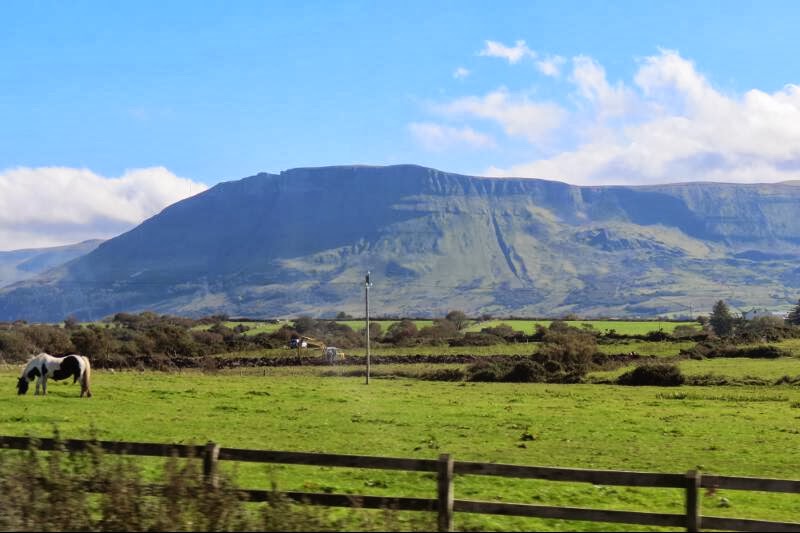
Benbulben. Sorry, all the photos in this post will be from the
same area.

I can remember my dad joking around St. Patrick's day that we should wear orange instead of green because we were Protestant. (Though over the years I forgot the color and used to tell people we were supposed to wear black. Bad memory; bad, bad memory. Go sit in the corner and think about what you've forgotten.)

Another significant event that crops up in Sean's history lessons is the Flight of the Earls, which predates the Battle of the Boyne by a half century or so. A couple of Catholic nobles with lands in County Donegal had accepted earldoms but later ran afoul of King James I, who eventually established the kingdom of Great Britain and who gave us the Authorized translation of the Bible, known popularly at the King James version.

The earls went into exile with the hopes of returning some day to reclaim their lands, but they never did. They represented for many the last of the Gaelic aristocracy. I'm fairly certain that we stop along Lough Swilly, which was the starting point for their flight. The lough opens to the sea in the north.

Our first real stop of the day will be in Ardara. We're supposed to see a demonstration of the making of tweed and stop at a business called Triona Designs. A woman there tells us about the production of the fabric, which had its own particular plaid pattern, passed down through the family. I've put links to a couple of videos I shot at the bottom of this post. (Why just links? Well, they're not the most fascinating vids, and rather than tempt you to click now, I thought I'd give you a bit of a choice.)

She's quite practised with her presentation, but really, if you've ever been to  a state park or a traditional village that puts on demonstrations of colonial or pioneer days, you've seen and heard about the process. We'll be served our choice of tea and scones or Irish coffee (Sharon and I go the tea and scones route), but the real purpose of the trip seems to put a bunch of American tourists in a shop where they will pay a chunk of change to be able to say they'd bought authentic Irish sweaters or caps from a genuine Irish family business. I will say the scones were delicious. Starbucks and Panera could take lessons.

We've a bit of time before the bus leaves, so Sharon and I cross the street where a church and its cemetery were located, Parish cemeteries are the norm here, as they once were in America. This church has a decent sized lot, with space for a parking lot and a prayer garden, but it's also located next to a small hill. They terraced the land to make space for the dear departed. Celtic crosses dominate the scenery.

We jump back on the bus and head for Donegal, which in Irish Gaelic translates as Fort of the Foreigner. We have time here to grab a bite at one of the cafes on the diamond -- not the square. The Diamond functions as a meeting area and contains a large obelisk that honors the Four Masters, who are ancient Gaelic historians. Kinda the Venerable Bedes of early Ireland.

I'm thinking that this must have been one of the times when I failed to charge my camera battery the night before because Sharon has a lot more pictures than I do.

Castle Donegal dominates the area next to the Diamond. The O'Donnell clan chieftain built the castle in the 15th century, and significant additions were made in the 17th century. We walk all the way 'round the castle taking pictures, and at one point Sharon clambers up on a raised area so she can take a picture of the castle through the wrought-iron fence. We don't know whether people are allowed up there, and she tells me that one man who walks by while she's taking pictures mutters something about tourists. Yep, that'd be us.

While walking back to meet the bus, we pass a shop with a unique specialty -- zombie tattoos and makeup. Sitting in the middle of this ancient, quaint burg, it seems somehow out of place. I took a picture of one of the more socially acceptable windows. It's over on my Flickr page: http://www.flickr.com/photos/moconn852/10525323626/in/set-72157637027819346

Our next stop will be in Drumcliff, and on the way we pass through Ballyshannon. Ballyshannon claims to be the oldest town in Ireland and housed an important RAF base during the second World War, if I remember correctly what Sean told us as we drove through.

I'm not sure that Ballyshannon was the place, but I know a river runs through the town, and being connected to the ocean, it's a tidal river, as are many of the rivers we see near the coast. I'm reminded that on our way through one town we were treated to the sight of a bunch of boats lying on their sides on the river bottom waiting for the tide to rise and make them float again. As we drove past, we saw a man, presumably the owner, climb up into one of the boats.
W.B. Yeats gravesite. Photo by Sharon O'Connor


The drive to Drumcliff will take us by a mountain called Ben Bulben, or Benbulben, or Benbulbin. William Butler Yeats is buried in the churchyard at Drumcliff, which is supposed to be the attraction we stop for, in the shadow of Ben Bulben. The last three lines of his poem, "Under Ben Bulben," are etched on his headstone. In fact, the whole last stanza of the poem references his wish to be buried there, and Sean recites the lines before we arrive at the cemetery:
Under bare Ben Bulben’s head
In Drumcliff churchyard Yeats is laid.
An ancestor was rector there
Long years ago, a church stands near,
By the road an ancient cross.
No marble, no conventional phrase;
On limestone quarried near the spot
By his command these words are cut:

     Cast a cold eye
     On life, on death.
     Horseman, pass by!
 I know now that Yeats won a Nobel in Literature, and I ran across him in an online course I took in poetry, one of those projects in which I go back and read or learn stuff I was supposed to have learned in high school and college on the theory that it will be good for me, which it was.

But I'm not a poetry convert in the sense that I still read much of it or try my hand at it. So I'm not all that excited about seeing the grave or the little monument set up just outside the entrance to the church grounds. Some in our group feel the need to have their picture made with the statue or next to the headstone. To each his own.

I'm more interested in the ancient cross mentioned in the poem. A Celtic cross looms over  a section of the graveyard, and the sign below it reports that the cross is one of the oldest of its type in the country.

Legend has it that St. Columcille, or St. Columba, established a monastery in Drumcliff in the middle of the 6th century. The cross was a later addition and dates from the 9th to 11th century, depending on who's doing the dating.
Monastery tower. Photo by Sharon O'Connor

Across the road from the cross stands a round tower. Sean had told us about these towers, which the monks built to protect themselves from invaders. The door is about 15 feet above ground, and when threatened, the monks would climb up the ladder, enter the tower and pull the ladder up behind them. Clever, eh?

Of course, the invaders learn how to smoke them out by, um, smoking them out.

Somehow I managed to not shoot an acceptable picture of the tower, so I've put one of Sharon's in this post.

The rest of the day escapes me, but we are headed for Westport and the promise of pirate stories. Sharon named her sailyak after a pirate ship, so I know she's excited about the prospect of encountering old-time pirates, and a bonus will turn out to be that the main pirate in question is a woman. More on her in the next post.

Video links:
Running the loom:  http://youtu.be/NovKguni2xc
Discussing the fabric making process: http://youtu.be/2kKj3Vyl2-4