Monday, November 14, 2016

We Go to a Land Down Under -- VIII

Reef-er madness


Sunday, Oct. 9


This is it. We’re going to the Great Barrier Reef! We are going to snorkel for the first time. At the Great Barrier Reef!

I wouldn't have minded being up early today, but we don't leave 'til mid-morning. We've all our stuff ready to go – including a towel pinched from the pool area. Tony told us yesterday that
Our chariot to the reef
he was obliged to tell us we could rent towels from the concierge, which would have been A$4 or so, but the hotel kept towels at the pool area. Then he gave us directions for finding the pool. Sure enough, when we reached the hotel he gave us a whole spiel in the lobby, loud enough for hotel personnel to hear, about renting towels and then told us that if we were interested in a swim in the pool, we would need to go to the third floor and then walk down the spiral staircase, omitting any reference to towels at that location.

As you can imagine, most everyone in the group wound up taking a towel to the reef with them.

After breakfast we meet with Tony in the lobby to go over some details and then take a short walk to the pier where the boat that takes us to the reef is moored. Several companies make runs to various parts of the reef. Ours will take us to a section known as the Norman Reef, about 35-40 miles away as the crow flies, or two hours on the boat.

We’re on a catamaran, which is fairly stable, but we will hit a couple of patches that make for a bumpy ride. A woman on the port side of the deck we’re on tosses her cookies not long after we leave. The crew treat her very kindly and rapidly take care of the mess. If I hadn’t happened to glance over there at the right time, I’d never have known anything about it.

Green Island
We make a stop at Green Island, an island that part of the larger reef area on which they've built a resort, and some of the passengers debark to partake of the resort's entertainment while we continue to the reef. A barge -- they call it a pontoon, but it's huge, unlike the pontoons I'm used to at the lake -- lies at anchor with a heliport anchored nearby. Almost everything we’ll need for the next few hours is on that barge.

We go to collect our snorkeling equipment, and the guy who helps Sharon and me asks if we are taking any medications. We tell him that we take cholesterol meds, and he says we have to sign a release. The release lists a bunch of conditions and medications, none of which have anything to do with cholesterol control. We point that out, but it doesn’t matter. After signing, he gives us a different mask and tube that apparently mark us out for the lifeguards so they can keep an eye on us.

Tony has volunteered to help the newbies, and after we are kitted out, we go find him. He’s helping one of our group who doesn’t even swim. He’s going to need to take some time with her, and we had seen a video on the ship that gave basic instructions on what to do, so we decide we’ll just jump in and give it a go.

An area is roped off around the barge representing the limits of where we’re allowed to go. It seems pretty large until you’re in the water with a couple of hundred other people. The side where we entered the water is to windward, so the waves and wind tend to push up against the rope. Also, the coral in this part is deeper, so we can’t see much detail. Wearing a mask in the water helps some with our myopia, but not that far away.

We push out toward the center and encounter Tony, now finished with the non-swimmer. He asks if we have any questions or problems and suggests we swim over to the other side of the boundary.

This is a good suggestion. We come much closer to the coral on that side and spot fish swimming by. But it’s still crowded, and another swimmer smacks into me, causing me to lose my mouthpiece and swallow a mouthful of water, which being saltwater is not a pleasant experience. I've been bumped entirely too many times and feel like I'm being pushed around by the waves, I need a break.

Shot this fish with the cheap underwater camera set
up I use when sailing. The wires anchor on of the rings
in the snorkeling area where swimmers can take a
break. That's not the barracuda, by the way.
They have some rings anchored around the area where swimmers can hang on for just such a break, and we head for it. As we near the ring, we spot a large, long fish floating not far away and start swimming toward it. Just about the time I think I could reach out and touch it, it swims off to a spot on the other side of the ring. Which is OK because we're not supposed to touch the animals or the coral. (And yes, I know living coral is an animal. You know what I meant.)

Another couple is hanging on the ring when we arrive, and I ask them if they saw the big fish. The woman says they did and says she thinks it’s a barracuda. Later we’ll be in an observation deck part of the barge, with pictures of the kinds of fish likely to be spotted. Sure enough, we recognize the photo of the barracuda. Sighting confirmed.

Best shot I got of the reef with my waterproof rig
I’m still feeling pushed around and not quite so excited about being there, so I get Sharon and we snorkel our way to a platform on the other side of the barge. I’m done for the day but tell Sharon I’ll see if I can find the boys so she can snorkel with them. Turns out lunch is being served, so I go back and get her to go to lunch, where we meet up with the guys.

By the time we’ve eaten, we discover that not much time remains until another attraction we’d thought about taking advantage of, a semisubmersible submarine, will be making its last run soon. We spend a bit of time on the observation deck watching fish go by. Some guy in scuba gear floats by, and one of the other folks on the deck says he’s the official photographer -- the one who takes pics of the guests in their various activities. She says he told her he has a couple of fish who follow him around, he’s become so familiar to them.

We catch that last sub ride and enjoy the short trip viewing the reef and associated fish. Then it’s back on the boat and back to shore. I know it sounds as though I didn’t enjoy the snorkeling, but I did. Given the chance, I’d do it again in a heartbeat, especially in calmer waters with fewer people bumping into me. Ultimately I would call it the high point of the trip.
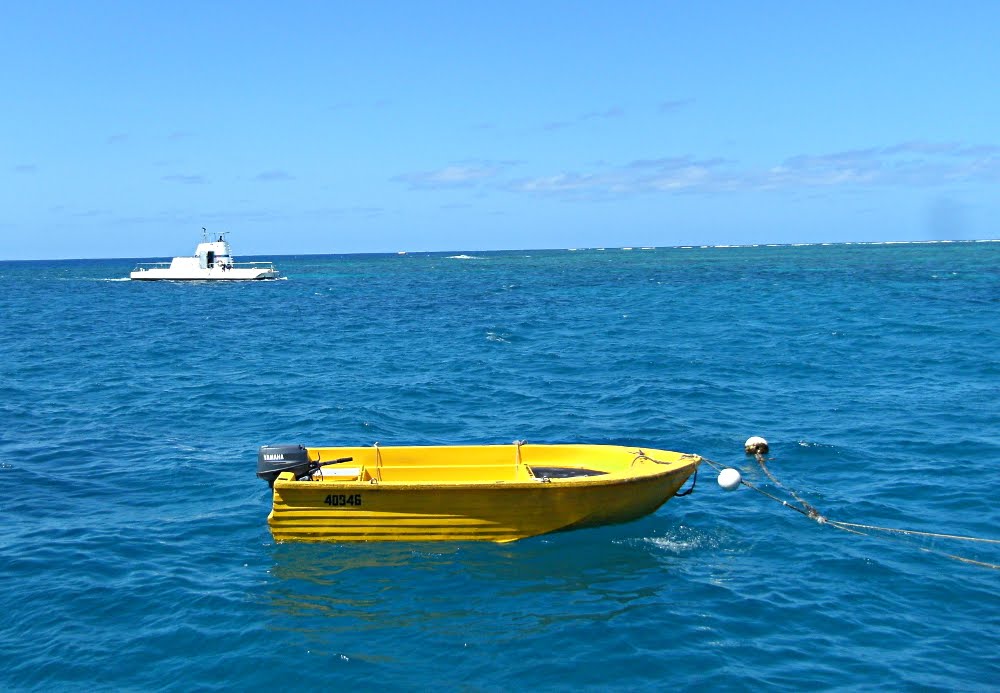
The semi-submersible in the background. A rope and float
set up like the one the yellow boat is moored to marked
the boundary of the snorkeling area.
You may wonder, as I did, about all this tourism going on at the reef so short a time after news outlets had reported on a study that said the reef is somewhere between 80 percent and 95 percent bleached. All I can say is that the government is supposed to strictly regulate reef tourism with an eye to its impact on the reef. I can hear the “hmmphs” being said while you read this. And honestly, I wouldn't have missed it for the world.

Back in Cairns we meet for a group dinner at a place called Dundee’s. I honestly don’t remember what I had, but I do remember it was delicious. Drinks we supposed to be included, but a couple of folks don't seem to understand that the selection is limited to a choice of beer, wine or a soda, and those of the restaurant's choosing. We've been sitting at the table Tony joins, listening to him entertain us with hilarious stories about eating food in America when a waitress approaches him to discuss how he wants to handle dealing with the mixed drinks that a couple of someones in our party ordered. Sadly story time is over.

We’ll have another group dinner in Sydney before we leave, and this one I remember because it’s a seafood linguine.

Foodie break: Someone asked me when we got back if we’d tried any exotic foods while there. Pfft. Of course we did, Aaron had an emu burger one day -- I tried a small bit of the meat and found it tasty. We tried kangaroo, also pretty good, and crocodile, a white meat that looks like chicken but that, to me, has less flavor and a softer texture. I can live without it. Our seafood linguine on the last night has baby octopus in it. Tastes OK, but you have to get over seeing an entire small octopus show up in your food.

Sharon and I often felt like we weren’t getting enough veggies in our meals and definitely not enough fruit, so we would often leave the guys to go explore the various available cuisines and go find a Woolworth’s to buy some fruit, which will be our supper.

Woolworth’s? Yep. In Australia it’s a grocery chain, though the larger stores are almost like a Walmart, carrying a variety of products in addition to the groceries. (The other big chain store is IGA.) While we’re in country we’re delighted to discover that TimTams are on sale at Woolie’s, as it's called locally, so whenever our stock ran low or out, we’d buy a package to go with our fruit. We also discover that cheddar cheese tends to be marked as tasty and extra tasty, which we take to be equivalent to medium and sharp here at home, though we didn't buy any cheese to find out. Don't remember what they called the cheese we decided had to be mild. Probably mild. Oh, and the cheddar is white.  

Sunday, November 13, 2016

We Go to a Land Down Under -- VII

Not quite on the dot-dot


Saturday, Oct. 8


Our hotel provides free use of laundry facilities and free laundry soap. Now, the laundry facilities comprise two washers and two dryers. With 48 tourists in just our group, you know the demand was high. But this morning the guys let us know that they’ve been using the machines and that they’ll be free soon.

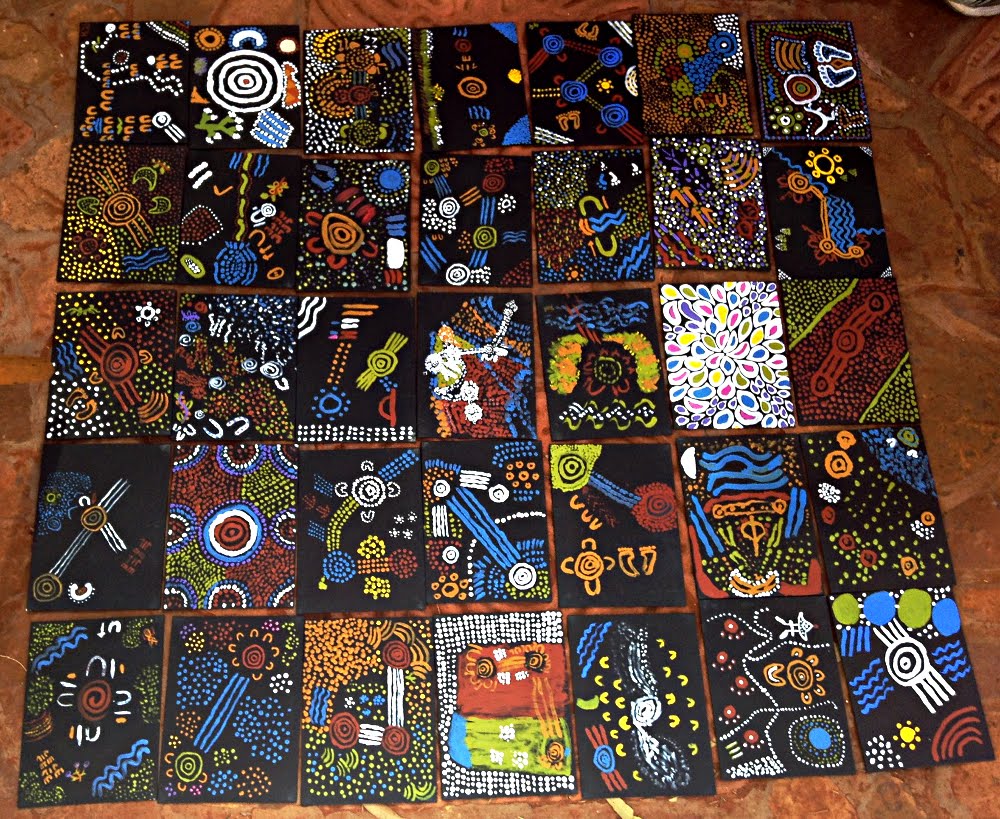
Dot-dot paintings by our tour group.
We already have a load fixed up and jump on the opportunity because we figure we’ll have just enough time before we leave for Cairns later in the day. We do, but I had a moment of panic because we get confused about the time thanks to the weirdness of the time zone shifts we're experiencing and to the clock in our room that’s not correct by any time zone. We’ve been unable to figure out how to reset the darn thing. I know my phone will have the right time, but I had glanced at the TV, tuned to a morning news show, and then the room clock.

This will be a travel day, but we don’t leave until after lunch, so we have an activity scheduled for mid-morning. We walk to the town center, which only takes a few minutes, to meet with a group that conducts sessions on Anangu lore and something called “dot-dot” paintings.

Two young women – sisters -- along with an Aboriginal woman discuss how stories were communicated through drawing in the sand. Obviously this kind of art doesn’t survive, so eventually the “dot-dot” painting was developed. The name describes the style. Using brushes and pointed sticks, the artist draws on a canvas by creating various sized dots -- but not like pointillism, where the resulting picture can show great detail.

Large sections will be covered with large dots. A certain amount of detail will be added with smaller dots. Certain symbolic elements are drawn on in another layer, and these symbols give the basics of the story being communicated in the painting. Because of the sacred nature of some of the stories, another layer can be added to obscure the story to the uninitiated. Tony has told us several times that these paintings can only be properly interpreted by their creators.

"Hey, mate. Whacha doin'"
"Just hanging around. You?"
"Getting a new perspective on life."
After the presentation, we’re led to tables with supplies so we can make our own dot paintings. Now, I probably wasn’t paying attention well enough, so I don’t realize that except for the symbols, mostly dots are used. I brush paint over a large section of my canvas and then add symbols for the story I’m trying to represent. One of the sisters looks at it and encourages me to add more dots. I don’t get the point she’s trying to make and continue on my track. When she checks in later, I tell her I've completed my painting. She points out that a large section of my canvas doesn't have anything on it and encourages me to add dots to the blank area, picking up a brush to help me out.

We’ll have a chance afterward to share the stories behind our paintings, and I wind up being the first to talk about my painting because I remember the native word for an implement women use. At the end of my description I make a crack about the dots the woman made me add to my picture, and she tries to cover by adding symbolism to my narrative. I think I wound up upsetting her a bit, but I’m sure she’s past it by now. In my defense, we had purchased a painting earlier that has a small section that's painting in a solid color and not dots, but I really need to curb my wise-acre nature, even if the person I'm kidding will never see me again.

Surprisingly to me, we will fly out of Yulara. They only make a few flights to a limited number of destinations from that airport each day. It’s a pretty small plane, but the flight will be short enough, and Qantas leaves more legroom on their planes than airlines do here.

"That bloke in the hotel used to be a journalist.
Let's give him the standard pose"
We’re flying to Cairns, which Tony tells us should be pronounced as though we have Boston accents, so it comes out more like “Cans.” Cairns is the gateway to the Great Barrier Reef and a thorough-going tourist town. Need proof? Find Cairns on Google Maps and then ask the app to show you souvenir shops in the town. Lots of dots will appear.

Our hotel overlooks Cinnamon Creek, which empties into the ocean and looks from our hotel room more like a bay or inlet. All of our tour group have rooms facing the water, and the view is spectacular. Cairns is a tropical paradise, quite a contrast to the red, sandy landscape we’ve come from. Our rooms also have balconies, and Sharon and I will spend a good deal of our free time on ours, watching and listening to the birds, taking pictures or sitting in the furniture reading and enjoying the splendid weather.

We join the boys for dinner at Splash, a seafood place on the Esplanade, the main road/area fronting the waterside. We dine al fresco and one of the waitstaff who helps us is from Paris, her accent adding nice touch to the experience. The owners of the restaurant have their own trawler, so we’re guessing the food’s pretty fresh.

Foodie break: We eat a lot of seafood while we're in Australia. Why wouldn't you when you're on the coast much of the time? We’ll have prawns, which is what the Aussies call shrimp. Technically there’s a difference between the two, but they're all called prawns here. The ones I have at Splash are huge and delicious. We’ll also have the aforementioned shark, barramundi, scallops, calamari, baby octopus, etc., etc., etc. I loved every bit of it.

While watching morning TV one day -- morning TV shows are much like they are here, a mixture of hard news, not so hard news, and downright silliness -- one of the featured stories is how a group of researchers in Australia is developing larger prawns and hope to create a variety as large as a lobster – and that would still be tasty. Prawn steaks, anyone?


We stroll about on the Esplanade for a while before returning to the hotel. The next day will be one of the top highlights of the trip -- we’re going to the reef!

Part of the Esplanade at night. Reminds me of the old
Chesapeake Christmas display in downtown Fort Worth

Friday, November 11, 2016

We Go to a Land Down Under -- VI

In the Time of Creation


Friday, Oct. 7


Kata Tjuta

Several intrepid members of our group decide to take in the sunrise at Uluru while others are dropped off to take a hike around the mountain. Tourists like to climb the mountain, but because it’s a sacred site connected to aboriginal creation stories, the government officially discourages climbing the mountain. This is sort of a compromise. The native peoples would like a ban, but the government wants to keep the tourists happy. Thus the “compromise.” All the official literature discourages climbing, and in the park gift shop, you can buy a T-shirt that proudly proclaims you did not climb. Tour operators also strongly encourage their entourages to stay off the mountain/

We skip the activities because departures are way earlier than the ones we've experienced up to now, and we’re all tired of being up early. So our day begins at 8:30 as we board the bus for a closer view of the mountain.

While we drive to the site, Tony tells us some of the folktales that adhere to Uluru. He explains that both he and our driver, who also runs tours to the mountain, have to be certified to tell the stories. Even then, the stories he relates are considered to be the children’s versions, and the more complex tales are reserved for the older native peoples.

We drive to a trailhead that will lead us to the Mutitjulu waterhole. As we walk by various formations, Tony tells us of an epic battle between two snakes and points out the formations that resemble snakes and the marks on the mountainside that correspond to elements of the story.

One of the rock formations looks like a blunt-nosed snake, and among the lessons contained in the tales is that snakes with this kind of head are not poisonous, Another formation resembles a snake head with sharp, angular features, and we learn that this is an indicator that the snake is poisonous.

That heart-shaped mark at the top is really
a backside-shaped mark.
When we reach the waterhole, we hear yet another story. The waterhole is not spring fed, though some once thought so, but is filled by rain running off the mountain. Up on the side we see holes in the rock, and sure enough, they correspond to elements of the story we’re hearing. One mark looks like a heart to me, but in the story it’s the result of a woman sitting on the ground. Just below that a hole represents the mark made by her knee as she stood, and another below that represents where she struck the ground with her wanna, an all-purpose stick used by tribal women.

Rock paintings at Uluru
On our way back to the trailhead, we stop at an area containing paintings by the Anangu people. At least one of them seems to represent Alita, Uluru and Kata Tjuta, the three mountains that rise from the ground. These three formations lie in a line when viewed from above, and the perspective of all the paintings is also from above. When Tony asks the group why we think that’s true, I can't help turning to Sharon and saying, “Ancient Aliens.” Fortunately he didn’t hear that.

This aerial perspective is used for traditional stories that communicate sacred realities, often creation themes, and at least in part, the perspective helps obscure the message to the uninitiated. The paintings and drawings also serve as maps.

What do you think? Was that the dingo that ate her baby?
Back at the trail head we see a dog wandering down the path. Of course the assumption is that this is a dingo, and the group's cameras start clicking. But our driver, John, says it's more likely a regular dog running loose because it lacks the distinctive white markings of the dingo. I’m going to take his word for it, but this dog looks to me like it's at least part dingo from the pics I find online later.

We reboard the bus to take a drive around the entire mountain, with Tony continuing to tell us traditional stories. At some point we are asked to stop taking photos, another agreement to respect the sacred nature of the site. Along the way we’ll stop off at the park's cultural center. We can take pictures outside but not inside because the inside houses displays telliing stories we’ve heard during the morning.

We’ll head back to the hotel late morning, as the temperatures as rapidly rising into the 90s, and they don’t want us wandering about in the near desert in that kind of heat. This shouldn’t be a problem for those of us from Texas -- and most of the Texans in our group are from North Texas, where it's considerably more humid -- but we’ll be back out in late afternoon to visit the formation known as Kata Tjuta, another sacred site associated with creation stories, and the Walpa Gorge, a part of Kata Tjuta.

Kata Tjuta is more elongated and segmented than Uluru. We stop at a lookout on one of the long sides of Kata Tjuta, At one end of the formation, you can see the trail that tourists take to climb the mountain, though as with Uluru, they are discouraged from doing so. At some point stakes were driven into the ground to provide stability for climbers.

At the end of the lookout, you can see Uluru in the distance, about 12.5 miles away, and some other isolated formations sticking out of the ground Tony explains that those uprises are what's left of an ancient mountain range. Erosion and landfill over thousands of years left those formations

Gotta admit it’s pretty hot when we get to the gorge, but the real problem is the flies. Tony warned us that the flies can be bad during the daytime. Some of our group have purchased fly nets that you put over your head, but we didn’t because we really hadn’t been bothered much before now.

The flies home in on Sharon, as flying bugs have a tendency to do, and she begins to feel like she can’t breathe. The heat’s bothering both of us so we let the boys forge on ahead and turn back to a covered area to await their return.

Sunset at Kata Tjuta
When everyone returns we head for the west side of Kata Tjuta for the sunset. 

Sunset here is almost as spectacular at Kata Tjuta as at Uluru, though the formation from the west side is not as imposing. Gotta say, I’m really grateful for digital cameras. I shot twice as many pictures in two weeks as I took when I spent a month in India and Nepal four decades ago, and although the film wasn’t that expensive, the processing ran to a nice bit of change. Now the expense lies in the camera, which has evolved tremendously over the SLRs I used to have. I think I snapped more pics at Kata Tjuta than Uluru, just from playing with all the settings available to me.


One nice thing about the very late afternoon into sunset – the flies go away. Maybe they have an early bedtime so they can be up at sunrise to annoy the tourists.

Thursday, November 10, 2016

We Go to a Land Down Under -- V

That's One Big Rock


Thursday, Oct. 6


We have an extra hour this morning before we depart. Feels positively decadent, or something like that.

We will be on the road for most of the day driving to Yulara, the resort village near Uluru, which used to be called Ayers Rock. (It’s kind of like Mount McKinley in Alaska. A white surveyor named in honor of another white guy, but the locals always refered to it by its aboriginal name, and it's now the preferred official name.)

Camels were imported, and some were released into
the wild where they multiplied and are now
considered to be a nuisance. 
We'll be heading south and then west, covering about 277 miles, about 30 miles less than the drive from Midland to El Paso. Like this latter drive, there's not much to see, scrub and dirt, the occasional mountain. Unlike the El Paso run, we won't be encountering towns along the way. Oh, there's a couple of places to stop, Camel Farm, a tourist stop where some of our folks take camel rides around a track that might be a quarter-mile long, and a couple of roadhouses where you can get a bite to eat and find a modest place to stay, but that's about the extent of it.

And you'll rarely see traffic. I may have this wrong, but I think that while on this road we see a “road train,” a semi pulling several trailers behind it. I believe this one was pulling three.

Tony’s trickster nature rises up again during the trip. One of our stops will be in the middle of nowhere where we’ll get a chance to see a large salt flat, one of many that dot the area. Before we arrive at the stop, Tony says he’ll give $50 dollars to whoever is the first to spot Uluru. But if he/she is wrong, then the passenger will owe Tony. According to the schedule we’re a couple of hours away, but hey, we’ve never seen it and it might be so high and the ground so flat that you can see it from a long way off.

Mt. Conner
Sure enough, not much time passes before we’re able to see a large mesa on the horizon. Is that it? Some folks swear it is. But of course, it isn't. It's Mt. Conner, Atila to the locals. Part of this trick is just the way Tony is – he likes to mess with us -- but I think it’s probably also an effort on his part to encourage people to pay attention to the travel itinerary he gave us the first day. It's a good try, but the itinerary will be ignored by some people in our group pretty much up to the last day.

We stop at a lookout to take pics of Mt. Conner and climb a small sand dune to check out a salt flat, one of many that dot the route. Then it's back on the bus until we reach the Ayers Rock Resort, our home for the next couple of days. The resort is a conglomeration of hotels, shops, a museum, and restaurants whose sole purpose is to support tourism for the Uluru-Kata Tjuta National Park. It even has a small IGA grocery store that we will frequent.

Whereas Melbourne was blustery, rainy and cool, Yulara is sunny, dry and hot. Remember, they are as far into our spring as we are into fall, and the daytime highs are already in the 90s and forecast to hit 100 on the day we'll leave. Summer highs can go as high as 140. 

This night we’ll travel to a viewing area to see Uluru at sunset. Mind, there are hundreds of other people there to see it, but that doesn't detract from the experience. I would make a comparison to our trip to the Grand Canyon. We’d seen the pictures, but nothing prepared us for the grandeur of the actual place.

Uluru is “only” a bit over 1,000 ft high, but it's almost 6 miles around and sticks out in the middle of a mostly flat, scrubby, red plain. We're told that geologists believe it's like an iceberg, with some 80 percent of the formation lying underground. It's also loaded with iron, which makes it turn a rusty red at sundown – and sunrise, so I’m told. We skipped the opportunity to check it out the next morning.

While walking down a path to find some other angles on the mountain, we encounter a family. Sharon and the boys keep wandering up the path while I stop for a picture, and the parents start chatting with me. They’re Aussies on holiday and seem genuinely interested in whether we’re enjoying our vacation. I tell them how much the area reminds us of far west Texas and eastern New Mexico. Before long we’re chatting about our regular lives. They live in a town on the east coast that the father says is the eastern most spot in Australia.
The "arty," and now trite, shot,  Click to see this bigger
and notice that the mountain appears upside down in
Sharon's glass of water.

Uluru starts out being a sort of drab brown, but as the sun dips, it begins to brighten to a startling rust color, only to become drab again as the sun drops below the horizon.  I've dozens of pictures, and I realize I will have to turn one of them into a poster to come close to capturing the impact.


We return to the hotel and take a short walk into the central square to buy fruit and TimTams. Then it will be time to call it a day.

Wednesday, November 9, 2016

We Go to a Land Down Under -- IV

Play me didgeridoo, mate


Wednesday, Oct. 5


Today is a travel day, but we have to be up and at ‘em early in the morning, again. This seems to be a theme. What I like is when the schedule tells us the restaurant opens at 6, and we can have breakfast "at leisure, but we're leaving at 7. Fortunately breakfasts are full English breakfasts, basically a buffet with the usual morning pluss stuff we'd never eat for breakfast at home, like baked beans and vegetable sticks, so we don't have to wait to eat (unless you order an omelet.)

We will check in at the airport as a group, a concept that seems to be as foreign to most of the group as it is to us. I feel sorry for Tony, though – put 40-odd seniors in a group and suddenly you're dealing with a bunch of kindergartners who don't seem to be able to read or follow instructions.

Domestic flights don’t have as many restrictions as international flights, but they still do the random checks for drugs and explosives. Sharon and Brandon are tapped. (Sharon will be picked again before we leave the country and asks, “OK, what do they think old ladies are going to do?”)

We arrive in Alice Springs, part of the Australian Outback, at about 11 in the morning. This part of the country is in the Australian Central Time Zone, which is only a half hour different from the eastern zone, except they don’t follow DST, so it’s an hour and a half off Melbourne time. The whole time zone thing will be confusing. Cairns is in the eastern zone, but not on DST; Sydney’s fully a part of the Eastern zone with DST. Given that we’re only in country for two weeks, and that we’re skipping a huge part of the country, we undergo way too many time changes. Good thing you can get the time from your cell phone – especially given that the clocks in our rooms are never right, and most of the time I can't figure out how to change them.

Speaking of cell phones, Brandon’s cell phone works in Australia, but Aaron’s and mine don’t. We bought new SIMs at the Vodaphone store so we could keep up with each other if we got separated. Thirty bucks for unlimited talk and text and two gigs of data for a month. Given the exchange rate, that ain’t bad. Aaron thinks we're getting ripped off at home.

ANZAC Hill
We won’t go straight to the hotel after our arrival. Instead we’ll take a brief tour of the town, starting with the war memorial, which is built on ANZAC (Australian and New Zealand Army Corps) Hill, maybe the tallest vantage point in the town. From the hill you can see pretty much the entire town and the McDonnell mountain ranges that lie nearby.

Interesting thing about Alice Springs is that the town was not built on or near a springs. The earliest settlers arrived after the rains and mistakenly thought the water was a result of a spring. A large river bed runs through the town, so dry while we’re there that the only way to know with certainty that it’s a river is by the sign on the bridge near our hotel.

Mural at School of the Air. 
After hearing a bit about the history of the area and taking a good 360 view of the town we head for The School of the Air. If you take a look at a map of Australia, you’ll see that a large chunk of the country is arid to semi-arid, with small towns scattered about. Educating the children who live in this vast area – most of them living on cattle stations that would make Texas ranchers jealous – with few roads and fewer schools was a challenge. The School of the Air, now just one of several scattered throughout Australia and New Zealand, aimed to solve that problem.

Another service, the Royal Flying Doctor Service, which we will also visit, had established a radio network throughout the Outback that used radios powered by attached pedal-powered generators. This network became the basis for The School of the Air, allowing students to have real-time contact with teachers, though sometimes the reception was spotty. Students were mailed lessons and texts to complete them with, and they mailed the completed material back. Over time the school has adopted new technologies – television, computers, Internet, for example -- and the school sponsors regular get togethers so the students have opportunity to interact with one another.

The presentation here is scheduled to take a lot longer than is necessary to explain the operation, so we cover the same ground – how many students they have, how many thousands upon thousands of acres covered -- more than once.

The pedal power radio that started it all, or one like it
We move on from there to the Royal Doctor Flying Service headquarters. The RDFS, as you might guess from its title, flies doctors and nurses to remote areas of the country to provide medical services – from clinics that address basic health needs to emergency situations – to the underserved areas of the country. We view a holographic presentation detailing the history of the RDFS and its services, much more interesting than the presentation at School of the Air, and wander through a small museum before heading for the hotel.

After we check in, Sharon asks if we can go to the McDonald's to see if we can buy a soda with ice. Google Maps shows the Macca’s to be a short walk away, so we head off. Only problem is that I’ve never used Maps to go somewhere on foot, so I’m not sure we’re on the right route. We come to an intersection that I fear is too far along the route and while standing there waiting for the light to change, I tell Sharon I’m not sure where we are or how to get to where we want to go.

A young woman also waiting on the light overhears – actually would have been hard not to – volunteers to help us and gives us directions that will eventually bring us to our destination. But her directions actually take us on a much longer walk than we needed to take. Along the way, Sharon recognizes parts of the town we had seen while driving around earlier on the bus. She figures out what the best return route we should take is, a much shorter walk. She's good at that stuff.

Foodie break: We’ve had sodas in Melbourne from the convenience stores -- they have 7-11s by the way -- but they were all bottled. And we encounter a dearth of diet drinks. Diet Coke is a big seller and available pretty much everywhere, but I don’t drink it. Doesn’t matter much because giant sodas like we have here apparently don’t exist. And the bottled drinks have fewer calories than a comparable sized drink here.

At the McDonald's, we are able to purchase sodas with ice, the large being roughly equivalent to a 20 ounce drink at home. There are no drink machines, no free refills. On the news, though, we hear a discussion about the obesity problem and whether candy displays at checkout aisles contributes to the problem. One of the commentators brings up sugared drinks as part of the discussion. Seems a bit ludicrous compared with our situation, where folks come to the QT or RaceTrac with ginormous refillable tanks or to the 7-11 on special Slurpee promotion days carrying wading pools.

Our evening will be spent at Earth Sanctuary -- World Nature Center, a carbon-neutral event venue that hosts ecology, culture and astronomy tours, weddings, and tourist events such as the one we're on. We’ll be fed an Aussie barbecue and have the opportunity to sample damper -- a kind of camp bread. We’re also entertained by the owners who talk about the kinds of animal tracks that can be found in the Outback and give us the backstory to “Waltzing Matilda,” which according to them is really about a traveler dancing with his bedroll. After the minimal exposure we'll have to the Outback, though, dancing with a bedroll seems reasonable

A didgeridoo player performs while we’re eating. He’s not aboriginal and plays “contemporary” didgeridoo works, but I don’t know enough about the music to know the difference. He’s supposed to be one of the premier players in the country though. At the end of his set, he pulls out a bunch of instruments to pass out among the crowd and attempts to teach us how to play. I’m able to produce some of the sounds, but I can’t sustain them. Apparently you have to use your diaphragm to pull in air at the same time you’re blowing out. Pretty cool skill if you can pull it off.


We end the night with an astronomy lesson, looking at the Southern Cross and learning how to use it in conjunction with the Pointers to find south. We also have a spectacular view of the Milky Way because we are far from the kind of light pollution that reduces the famous ribbon to a so-what dribble of stars across the sky. The star views alone would have made it a great night.


Our group has loosened up at this point, more so than the two drinks they've been served during the evening can account for, and we have a pretty rowdy ride back to the hotel. But the evening saved the Alice Springs stopover for me.

Tuesday, November 8, 2016

We Go to a Land Down Under -- III

The Great Ocean Road


Tuesday, Oct. 4


We are up too early again today for all the same reasons. But we’ve signed up for a daylong tour traveling the Great Ocean Road, which will take us to a famous coastal formation known as the Twelve Apostles. 

Tony always meets whatever group is departing to make sure everyone is there and knows which conveyance to board, and his puckish side comes out as we board our bus. He tells us to be sure to sit on the left side of the bus because that’s the side the ocean will be on, and we’ll have a better view. Being the trusting souls we are, the people from our tour group dutifully take over the left side of the vehicle.

But we don't need to do that. We'll be taking an inland route to begin the trip, and we'll spend large periods of time traversing forests, As we travel along, we figure out we've been had and begin to spread out.The first part of our journey didn’t follow the Great Ocean Road because heavy spring rains had caused widespread flooding in the southern parts of Australia, and landslides had closed a large section of the highway. 

Sheep dot the hillsides. Those are eucalyptus trees
on the horizon.
We claw our way out of town past the early morning traffic endemic to large cities before reaching the countryside. But what beautiful countryside. Rolling hills with sheep farms scattered along the way. Eucalyptus trees that form a unique silhouette on the horizon and hold the promise of koala sightings. It's hard to grab pictures through the bus window, and my descriptive skills are inadequate to properly convey the sights. But you can go yourself someday and see it for yourself.

The weather promises to be wild this day. The forecast is for rain and wind, and it is windy. By that I mean West Texas spring wind windy to strong gale force windy. Waves of rain move up from the coast, but we often manage to make a scheduled stop at a time when the clouds break and then leave just as they close in again. 

Old bridge at Winchelsea built by convicts. Only used
for foot traffic. The large tree on the left is a white gum,
a kind of eucalyptus tree with a smooth bark that leaves
a white residue if you rub it.
Foodie break: We stopped at Winchelsea for a morning tea break. Sharon and I drop in on a local bakery and buy a giant cinnamon roll to split, only they don’t call it a cinnamon roll so the woman helping us seemed a bit confused by our request. Unlike Cinnabon, they don’t drown it in thick icing. We didn’t find out what they do call the pastry we had, but the woman points out a cinnamon roll, which looks more like a flattened loaf of bread or a strudel.

Meantime, Aaron and Brandon visit the grocery store and discover a cookie, or biscuit , as it’s called in British English. (Biscuit can also be the term for what we call crackers. Confusing.) Anyway, this isn’t just a cookie; Apparently it’s basically the national cookie -- the TimTam. Imagine a rectangular Oreo with chocolate filling that’s way better than Oreo icing, and then the whole thing is dipped in chocolate. Later we discover that TimTams come in a wide variety of flavors. The Aussies are so confident that visitors have fallen in love with the TimTam that the stores in the Sydney Airport have large displays of them and even sell them in bulk, with a fancy, zippered bag containing eight packages.

One last food item before we return to the tour. We choose George’s Takeaway when we stop for lunch in Apollo Bay on Tony’s recommendation. He says they’re fast, and they are. We order fish, which the menu board says is made from gummy flake, and chips, None of us have a clue what kind of fish that is, so one of the guys looks it up. Flake is the Aussie term for shark meat, and it’s a descriptive term. Firm, flaky and delicious. Oh, and the gummy shark’s not endangered, so we don't feel bad eating it. My subsequent jokes about us eating the shark instead of the shark eating us are almost universally met with stares.  

Though it won’t always be true, we often find that we have to pay extra for “tomato sauce” -- what we would refer to as catsup. Given how often we’ll eat “chips,” or French fries, the extra buck it usually costs could add up. But paying for the condiment becomes less common in the later parts of the trip.

Sharon checks our the rocks on the beach at Apollo Bay. 
Apollo Bay also provides plenty of photo ops. Nice beach, winds driving decent waves, quaint little town, tourist shopping and plenty of places to eat. I buy an Aussie bush hat while here because I'll need a hat later in the tour, and I didn't bring one with me.

We make a few other significant stops during the afternoon. 

At one of our stops  the weather cooperates long enough for us to take a hike on a trail that loops through a rain forest at a place called Mait's Rest. Giant ferns mix with trees so straight that sailors used them to make replacement masts for ships. Other trees grow so high you can’t see their tops when you look up. Still others had trunks so large their age is estimated to be in the hundreds upon hundreds of years.

One of the koalas we saw.
Shortly after our driver pulls over in an area where he’s spotted koalas before. Sure enough, some in our group spot one in a tree right next to the bus when we get off. This bunch has debarked from a door in the middle, so the driver is unaware of the find and leads a bunch up the road where he's spotted one of the critters in a tree that sits a bit farther off the road. We snap pictures until raindrops indicate approach of another squall moving through and reboard the bus just before it hits.

Two of the stops are devoted to seeing the formations known as the Twelve Apostles, monoliths carved from the coastline by the waves and wind. Not sure how high the wind is while here because I hear different numbers, but I am sure that the sustained winds and the gusts are higher than anything I experienced before. The weather changes rapidly, sun, then clouds, then spitting rain. Holding steady long enough to get a clear photo is a challenge.

Waterfall at Loch Ard.
But the scenery is beautiful, and we stay out as long as we can stand it. At the second site we visit, Loch Ard, we’re treated to the sight of a large waterfall being blown sideways. And it’s thrilling to see waves crash against the rocks and splash at least halfway up the 150 feet tall formations. The winds grab the sea foam and send it soaring into the sky so that it looks like it’s snowing when it blows past us on shore. We all think it would be really cool to experience the area on a calmer day, but we also all agree that this experience is cool as well.

The other memorable stop is less a stop than a drive-by. Our driver is looking for an area where he’s seen kangaroos before. Eventually he spots one well off the road. He has nowhere to pull over so he slows to a near stop, but just as I’m about to shoot, he picks up a bit. He also starts honking, which I assume was an attempt to urge the creature to bound away so we can watch. It doesn't start hopping, but this whole routing makes it quite difficult to shoot a photo. Finally I start shooting through the window in the general direction of the 'roo and hope I get something. Sharon’s frustrated because she can’t get the shot. In the end, I wind up with this one, a bit fuzzy but recognizable.


Our last stop of the day is in another picturesque town, Port Campbell. We take care of personal needs, grab some pics as best we can with the wind blowing and rain spitting at us, then get back on the bus for a long trip back to Melbourne by another interior route. To entertain us, the driver plays “The Man from Snowy River” on the bus’s video system. Me, I sleep most of the way back. I’ve seen the flick, and it’s not good enough to worry about staying awake for.


Back at the hotel, darkness has fallen, and though it's not that late, we’re done for the day.

Sunday, November 6, 2016

We Go to a Land Down Under - II

Doing the block


Monday, Oct. 3


We are up entirely too early. First, because we're on vacation, and second because you don't sleep that well, even though you're tired out of your mind when you retired, when your internal clock is 16 hours off.

Flinders Street Station with the Eureka Tower
in the background. The tower's exterior design
commemorates the rebellion of 1854 
Today we'll take a tour of the city. We begin down at the railway station, whose clock tower is our touchstone, Tony tells us. Find that, he says, and you can figure out how to get back to wherever you need to be. For the area we'll spend most of our time in, that's absolutely correct.

Catercorner from the train station lies St. Paul’s Cathedral (Anglican). The main part of the church was completed in the 1890s, but the spires weren't added until thee decades later, and are constructed from a different colored stone. After the completion of the spires, the cathedral was the tallest building in town, and though it no longer holds that title, it is still the tallest church in Australia.

Federation Square
Across the street and a bit down from the cathedral is Federation Square, a mixed-used development at the edge of the business district with a distinct style of architecture that doesn't fit with anything surrounding it or even with the ultramodern highrises that dominate the central business district. As we walked by later in the day, we noticed a giant sculpture of a baby hanging upside down in one of the open spaces in the square. It was designed by an Australian artist, I learned later.

Baby sculpture at Federation Square
Although the town dates back to the end of the 18th century, Melbourne as a city really took off during Australia’s gold rush in the 1800s, becoming the economic hub of Australia and the capital of the then province of Victoria. The city was flooded with immigrants from around the globe, and coupled with the flood of immigrants after World War II, the city remains a diverse collection of ethnicities.

One of the modern highrises downtown pays tribute to one of the key events in Australian history. As you can imagine, the British government was thrilled with gold find and the opportunity it provided to profit both directly through the gold and through the typical bureaucratic process of charging fees for just about anything someone might want to do in connection with mining the gold.

In 1854, miners in Ballerat, Victoria, staged a short-lived and ultimately disastrous rebellion, known as the Eureka Rebellion. Among their issues was that they were being taxed without representation through the imposition of fees to obtain a license to conduct mining. Despite their loss, a system for popular voting in parliamentary elections was instituted. The highrise reflects the colors of the rebel flag, blue and gold, and features a long, red stripe that signifies the blood shed during the failed revolt.

From St. Paul's we'll take a short walk to a unique feature of Melbourne's CBD -- laneways, what we would call alleys. Originally pathways used by workers and servants to reach their places of employment and places where the trash was taken into commercial areas, the laneways evolved, mostly after World War II, into districts with their own individual personalities.

Graffiti in Centre Place
One section, called Centre Place, is devoted to cafes and coffee shops -- and Melbourne is very proud of its coffee culture, Tony tells us. Starbucks tried to make an inroad but was only able to open about a quarter of the stores they planned to. Graffiti artists are allowed to operate by license in this and at least one other laneway, which draws locals and famous graffiti artists such as Banksy. Works will last a few weeks and then be covered over by other artists.

Ceiling in The Block
A pair sections we visited – The Block and the Royal Arcade – are devoted to upscale shops – high fashion, posh chocolatiers, very nice restaurants, that sort of thing. Moving from Centre Place to these areas is like walking from one planet into another. Stained glass archways, mosaic tile floors, statues that have been replicated from famous works in England. The Block and the Royal Arcade have long standing as part of the fashion shopping mecca of the city, and Tony tells us that it used to be quite the thing for the more well-to-do denizens of Melbourne to take a stroll in the area to see and be seen, an activity that came to be known as “doing the block.”

The Cook House
After our tour of the laneways, we hop on a bus to visit other areas of the city. Lots of gardens lie in various sections of town, and we stop of at one, Fitzroy Gardens, that contains a statue of Captain Cook next to his parent's house – there is apparently some debate over whether Cook actually lived there, and if so, how long – which was dismantled at its site in England and shipped to Australia to be reassembled in honor of the state of Victoria's centenary.

On, then, to the city’s war memorial, the Shrine of Remembrance, a large building across from the botanic gardens. Built to resemble the Greek shrines, its design allows for a unique light trick. An opening in the ceiling allows a ray of light to fall on what's call the Stone of Remembrance, at 11 a.m. on Nov. 11 each year, in commemoration of the signing of the armistice in 1918. The stone carries the words, “Greater Love Hath No Man,” etched in four lines. The ray highlights the word “Love” on the stone.

Also, from the top of the steps that face the CBD, you can see a building downtown whose external design features the face of King Billy, a famous Tasmanian Aboriginal leader.

We skip exploring the memorial in favor of walking around the botanical gardens next door. They are enormous. Pathways branch off every few yards, and you could spend the entire day there without seeing the entire place.

We have the option of going back to the hotel at the end of the tour or hopping off at Federation Square and walking back, which we do. The bus driver recommends a walk along the river, which we’ll do after a bit of shopping and some lunch.

We eat at a local pizza place -- pizza may well be more popular here than at home -- but had we yearned for the taste of home, we could have eaten at McDonalds’s, which the Aussies call Macca’s; or Hungry Jacks, the logo and menu being the same as Burger King; or Subway’s. Lots of American brands here.

The Travelers
After eating and shopping, we make our way to the river area, which will take us back to the hotel. The riverwalk is quite charming, but I can’t say the same for the river, the Yarra. Tony told us that the area the rivers originates from leeches mud into the water, especially after heavy rains such as they’ve had recently. So, the river's brown. And a bit trashy in spots where the trash can collect. At one spot a large amount of trash is corralled alongside the walk. An accompanying sign urges people to keep their trash out of the river. I’d say the campaign's not working.

Some art installations dot the way, including one that’s basically a protest piece. The one I like best is a bunch of metal sculptures that line an old bridge. I look it up after we return home and find that the bridge was part of the route immigrants would take from the harbor at Port Phillip to the Flinders Street Train station. The bridge was later abandoned and fell into disuse until it was repurposed as a pedestrian walkway. The statues were commissioned to line the bridge and the collection is called “Travelers” in honor of all the immigrants who crossed the bridge. We snap the appropriate pictures along the way and eventually return to the hotel.

Later we’ll walk back toward the train station to find a place that’s well rated for its burgers and call it a night.

Foodie Break: A note about burgers in Australia: As you would expect, the country puts its own spin on a food familiar to us. We ate burgers a few times and occasionally were able to order a variation somewhat similar to the standard American burger, bun with meat and veggie combination of lettuce, pickles and tomatoes. The chain places served the American version but had Aussie variations, though we never ate at one of them.

Mostly, the places we ate at made their own buns and offered a variety of ground meats such as beef, lamb, emu or kangaroo. Vegetarian patties were often on the menu. Cheese tended to be white cheddar. Bacon was often offered, along with a fried egg. Pineapple and beet root -- large slices of pickled beet -- were popular options. It seemed as though you were more likely to have beetroot on a burger than tomato. And it wasn’t bad, added a bit of tang to the taste.